Human Curation, AI-Assisted
Selecting music for a brand campaign, film, TV programme or other media project still starts with a person listening.
Someone has to understand the brief, the picture, the audience and what the music needs to do. They need to know when a track feels right, when it feels too obvious, and when something unexpected could work better.
That is the starting point for our work at Light On.
We are now working with MusiMap to add another layer to that process.
What MusiMap actually does
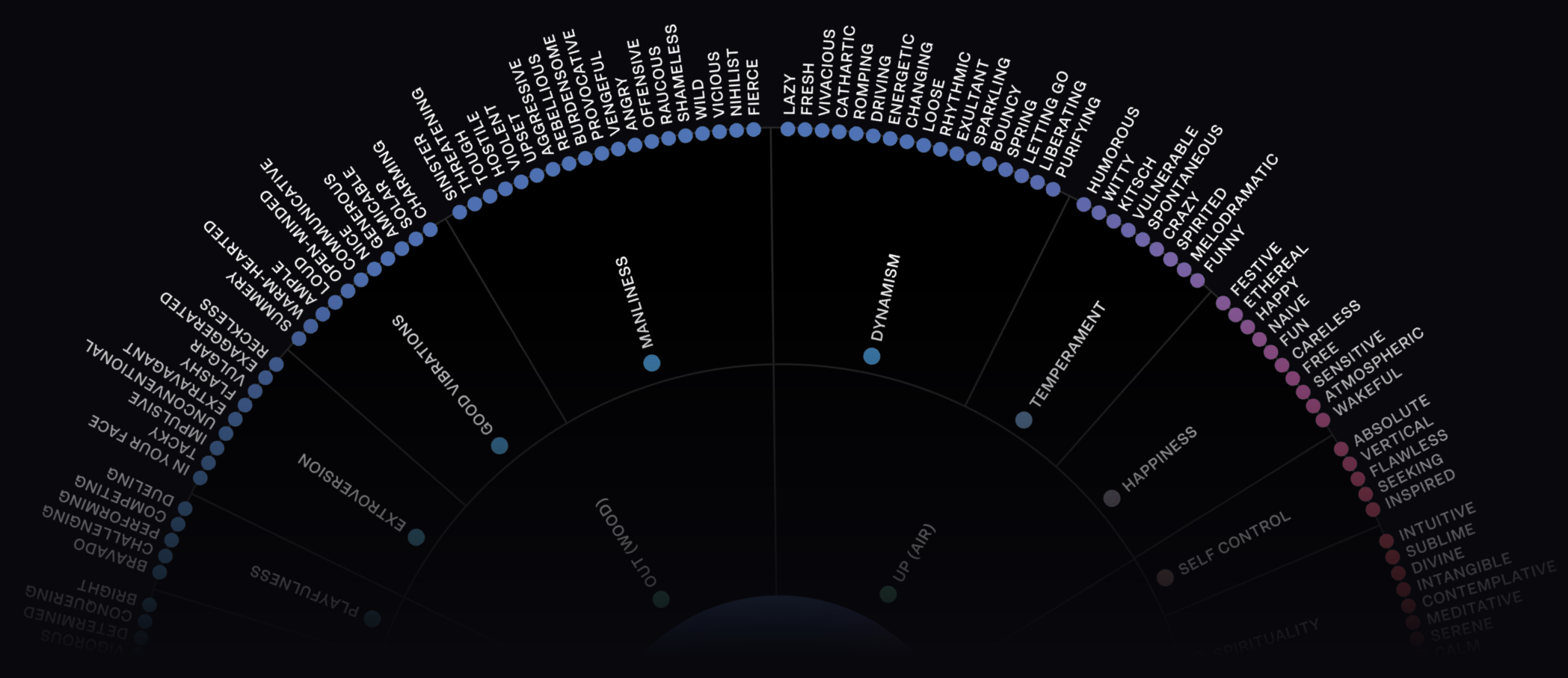
MusiMap analyses the audio itself and breaks a track down into a detailed set of musical characteristics.
That can include BPM, key, energy, danceability, genre, mood, situation, vocal characteristics and rhythmic qualities, among other attributes. The system can then attach weighted scores to those characteristics, giving us a much more detailed picture of what a track actually contains.
So rather than a track simply being tagged "Electronic" or "Indie", we can see a much richer profile.
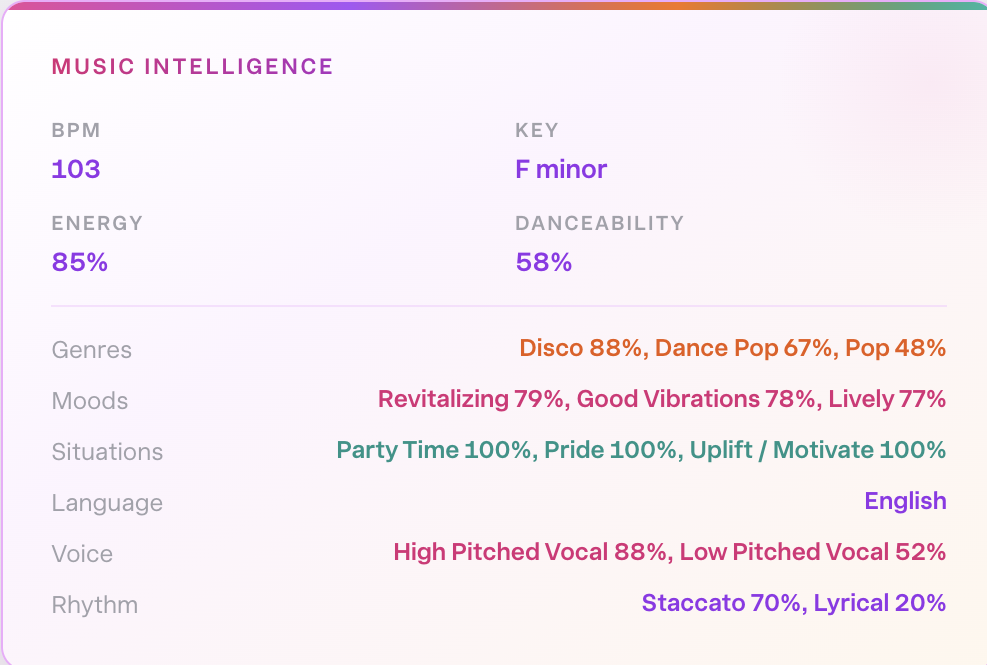
For example, MusiMap's own analysis of Stayin' Alive identifies it as Disco, Dance Pop and Pop, but also gives it scores for things such as energy, danceability, moods including "Revitalizing" and "Lively", and situations including "Party Time" and "Uplift / Motivate".
That level of detail becomes useful when we are searching for music against a creative brief.
From a brief to a shortlist
Imagine a brand brief asking for something energetic, modern and optimistic, but not overly commercial.
Or a director looking for something tense and hypnotic without making a scene feel sinister.
Or an agency looking for music that feels like a particular reference track without simply copying its genre.
We can use MusiMap to explore those characteristics across a catalogue and find tracks that share particular musical qualities.
Its search technology can work across moods, genres, audio attributes and musical meaning, while its similarity tools can help find tracks related to a specific piece of music.
That gives us more routes into a catalogue than searching by artist, genre or keywords alone.
The music still has to pass the human test
A track can score highly against a brief and still be completely wrong.
Music is being used in a scene, a campaign or a piece of content. It has to work with the edit, the dialogue, the visual identity and the audience. There is also the question of the artist, the cultural context, availability, rights and budget.
That is where curation comes in.
We listen to the tracks, compare them against the brief and the reference material, and make the creative decisions. MusiMap helps us investigate the catalogue and find possibilities. The final choice remains a music decision.
Finding music we might otherwise miss
This is probably the most interesting part for us.
Traditional metadata is useful, but it can limit the way you search. Two tracks can belong to completely different genres while sharing a particular mood, energy, rhythm or musical character.
MusiMap is built around this idea of describing music beyond basic metadata. Its underlying vocabulary covers moods, genres, situations and musical attributes, developed through decades of research and expert music annotation.
That can open up a catalogue.
Instead of asking only, "What genre is this?"
We can start asking, "What does this actually sound like, and what else has those qualities?"
Why this is useful for Light On

We work across brands, agencies, film, TV and media, where the music brief can range from a very specific reference to something much harder to describe.
Sometimes the right track is already sitting in a catalogue. The problem is finding it.
MusiMap gives us a way to search deeper into that catalogue.
Our job is to bring the brief, the taste, the context, the relationships and the rights knowledge.
Put the two together and we have a better way of getting from a creative idea to the music that actually works.